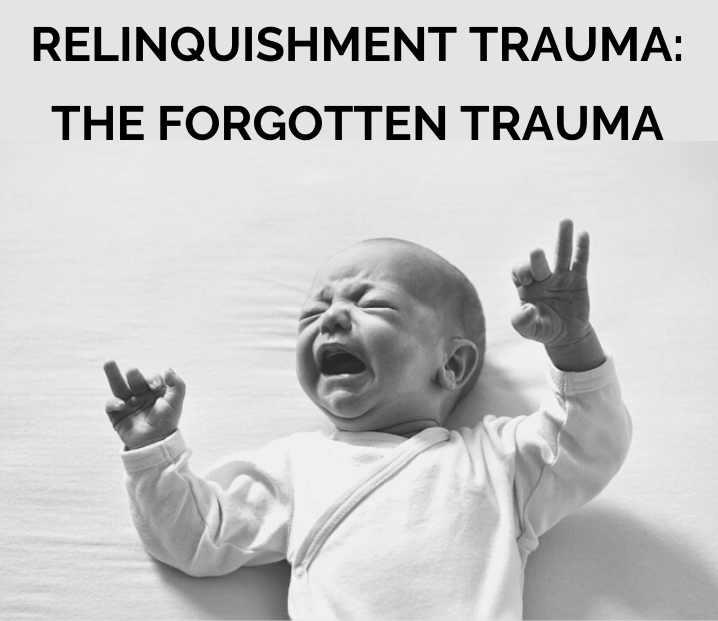
In this blog post, you will find information on relinquishment trauma (aka adoption trauma, adoptee birth trauma, adoption separation trauma, primal wound) and how trauma changes the way an adoptee views and interacts with their world. Relinquishment trauma is a trauma that could contribute to developmental trauma disorder in youth or complex post-traumatic stress disorder in adults. The relinquishment trauma information discussed in this article synthesizes stories of adoptee trauma symptoms with developmental trauma research, prenatal experiences, and how the brain and body change in response to traumatic stress.
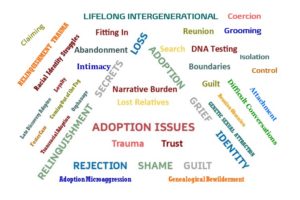
There are many different types of adoption trauma. Spending time in foster care, an orphanage, or an infant home is traumatic. An adoptee raised without information about or contact with birth family may experience the trauma of genealogical bewilderment. Being transracially adopted with no relationships with individuals of the adoptee’s race or ethnicity during childhood can be traumatic. Additionally, learning you were adopted as an adult (late discovery adoptee) can be a traumatic experience. Being raised “as if” they were born into the adoptive family, with adoption and birth family being unsafe topics to talk about is traumatic invalidation, a type of psychological abuse. The trauma experience can become worse when the adoptive parent minimizes the adoptee’s lived experience, grief, and fears of abandonment. When trauma occurs in childhood, youth are at risk for developing developmental trauma disorder.
Two blog posts on this website: Adoption Traumas & Complex Post Traumatic Stress Disorder and the Adverse Relinquishment and Adoption Experiences Assessment discuss the wide range of adoption trauma experiences adoptees, birth parents, and adoptive parents may experience.
How Does Adoptee Relinquishment Trauma Happen?
Research has shown that babies in utero learn their mother’s characteristics. These characteristics include the sound of their mother’s voice and her olfactory signatures during the pregnancy [1] [2] [3]. A newborn may become frightened and overwhelmed when the caretaker is not their first mother. The greater the discrepancies between the adoptee’s prenatal and early life -sound of the mother’s heartbeat, language, sounds, facial features, smells, the personal gait of walking, level of activity- the greater the stress on the infant.
When an infant is not with their first mother day after day, the infant can become anxious and confused, causing the infant’s body to release stress hormones. Even newborns that are placed with an adoptive parent within days of their birth may feel the terror of their mother missing. Adult adoptees often describe feeling like something is missing, they feel like they have a hole inside of them, or feel that their connections are fragile and insecure.
Birth psychology researcher Paula Thomson [4] states, “early pre-and post-natal experiences, including trauma, are encoded in the implicit memory of the fetus”. Many birth mothers had anxiety, depression, and post-traumatic stress disorder from their crisis pregnancy, the anticipated relinquishment of their child, and the horrible treatment they experienced during their pregnancy. This could set the stage for a child -the adoptee- to inherit a predisposition for depression, anxiety, or post-traumatic stress disorders.
An additional risk factor for an adoptee developing a mental health condition is when their mothers do not attach to them in utero. Lack of in-utero attachment is associated with a negative effect on the baby’s brain development, emotional regulation, and social behaviors, potentially leading to issues like ADHD, anxiety, and poor social interactions later in life [5].
The newborn’s trauma experience is multiplied when there are numerous caregivers and placements before the child joins their adoptive family. The number of caretakers babies and children have been exposed to in foster care, orphanages, lengthy hospital stays, infant homes run by adoption agencies, and college domecon classes can increase the likelihood that an adoptee will develop anxiety, depression, attachment issues, post-traumatic stress disorder, or complex post-traumatic stress disorder.
Relinquishment Trauma as a Developmental Trauma Disorder
When trauma researchers saw that the majority of children who experienced trauma did not meet the diagnostic criteria for post-traumatic stress disorder and were instead labeled with an unhelpful diagnosis that described behaviors (conduct disorder, oppositional defiant disorder), they developed a new diagnostic way to describe a child’s trauma symptoms. This led to the proposal of developmental trauma disorder to describe the trauma symptoms of children who experience abuse and severe neglect [5]. While the American Psychiatric Association declined to include developmental trauma disorder in the DSM-5, developmental trauma disorder has been accepted by many trauma researchers and mental health clinicians [6] around the world.
The diagnostic criteria for developmental trauma disorder state that a child or adolescent needs to have been exposed to:
“interpersonal violence or a significant disruption of protective caregiving as the result of repeated changes in primary caregivers, repeated separation from the primary caregiver, or exposure to severe and persistent emotional abuse”.
When most researchers and mental health clinicians think of incidents that lead to developmental trauma, they do not think of the separation of an infant from their mother due to adoption as meeting the criteria for disruption of protective caregiving, or multiple primary caregivers as meeting the diagnostic criteria for developmental trauma disorder. This leaves adoptee relinquishment trauma and adoptee infant trauma to be under-recognized by mental health professionals. This results in a shortage of mental health professionals who are both adoption-competent and trauma-competent.
You can watch Marie’s workshop Relinquishment Trauma and Its Impact on Adopted Persons by clicking the link below. The workshop was done for the National Association of Adoptees and Parents Happy Hour in June 2022.
What are the Characteristics of Relinquishment Trauma?
When trauma occurs, it causes individuals to view and interact with their world as if the trauma is happening in the present. An example is an adoptee who perceives their world as unsafe and struggles with mistrust even when they are with “safe” people in “safe” environments. Developmental trauma disorder symptoms that adopted children may experience include [7]:
- Emotional dysregulation – Children are easily upset and reactive. They stay fearful, angry, sad, or withdrawn due to difficulty recovering from emotionally triggering situations.
- Problems with sleeping, eating, elimination
- Overactivity to sound and touch
- Hypervigilant
- Extreme risk-taking
- Problems with goal-directed behaviors
- Low self-worth, feeling defective, helplessness
- Reactivity with physical or verbal aggression
- Anxiety causing difficulty with transitions and separation
- Poor capacity for self-protection, drawn towards relationships with individuals who repeat the pattern of poor attachment
- Difficulty in school, few peer relationships, and turbulent family relationships
With trauma causing trauma survivors to look at their world through the lens of the trauma, an adoptee may emotionally believe they caused the separation from their mother even though they intellectually know it was the decision of the adults involved, not them.
Developmental trauma may cause an individual to become emotionally stuck at the age the trauma occurred. Thus, we frequently hear adoptees described as “emotionally immature for their age”. This results from brain chemistry that interferes with the brain’s developmental trajectory. MRIs of children’s brains who have experienced trauma look different than their non-traumatized peers. Without resolution of the developmental trauma as a child, adopted individuals could develop post-traumatic stress disorder or complex PTSD as adults [8].
Trauma symptoms impact how an adopted person interacts with family and friends. A traumatized brain often responds with fight, flight, freeze, or fawning (people-pleasing) during stressful situations or when the implicit traumatic memories are triggered. Common scenarios of adopted persons reacting to their trauma triggers include: provoking an argument with a loved one and walking out knowing their loved one will go after them, running away as a teenager while leaving clues for their adoptive parents to find them, or emotionally freezing when boundaries are crossed. An example of a fawning response is people-pleasing behaviors that meet another person’s needs to decrease chances of rejection, even when the actions are not in the adoptee’s best interest.
When an initial trauma happens in adulthood, an individual can remember what they were like before the trauma. For example, a person knows what they were like before they experienced a war zone and how they changed because of their experiences. With relinquishment trauma and other early traumas (foster care, orphanage, infant home) happening in the first years of an adoptee’s life, there is no pre-trauma personality. The adoptee’s trauma symptoms (e.g., hypervigilance, ultra-independence, overreacting, perfectionism, absence of emotions, low self-worth) are seen as the adoptee’s personality. When trauma symptoms are removed, the Self that was always underneath the trauma symptoms can be seen.
Isolation, Secrecy, and Shame Negatively Impact Trauma
The life of an adopted person is impacted by the lack of information on their story and lack of validation of their lived experience. Adoptees can easily be made to feel that something is wrong with them when individuals dismiss their birth family losses. This can lead to an adopted person not verbalizing their truth. Suppressing feelings and thoughts is a normative response to invalidation. Subsequently, it can worsen trauma symptoms because a person is denying their reality.
Adoption Trauma and Relationships
The beginning of an adoptee’s connection to the adoptive parent can start with anxiety and confusion. The infant knows their caretakers are not their birth mother. Key to the adoptee child’s ability to attach to the adoptive parent is the adoptive parent’s ability to attach to their child without taking their child’s grief and anxiety of missing their first parent personally. When the adoptive parent does not feel entitled to parent, the infant can sense the parent’s ambivalence, creating further anxiety for the child.
A strong bond to an adoptive parent is a protective factor against a child developing developmental trauma disorder. There is extensive research showing that when adopted persons can talk to their adoptive parents about their adoption experience with genuine openness and no shame, the stronger the parent-child relationships and the adopted person’s risk for mental health issues decreases [8] [9]. That being said, an excellent relationship with an adoptive parent does not replace the birth mother.
When the adoptive parent has attachment issues (from their childhood or feeling their bond with their adopted child will never be as good because they are not the birth parent), it increases the risk of developmental trauma disorder. The relationship between the adoptive parent and child becomes further damaged when the adoptive parent minimizes the adoptee’s truth when adoption and birth family are not safe topics to talk about. It is traumatizing to an adoptee to be told they should feel “grateful” for being adopted and that they are “disloyal” for wanting to talk about their birth family and how it feels to be adopted.
The little t traumas in interpersonal relationships -lack of validation, shaming- are often more damaging than big T traumas because the trauma injury happened in a relationship that should be supportive. The little t traumas in family relationships that happen day after day, year after year have a cumulative negative impact on the trauma survivor, often more debilitating than a single incident Big T trauma. The extensive number of little t traumas over the years can cause extensive damage to an individual’s self-worth, identity, and ability to have healthy relationships.
Paul Sunderland has an informative lecture, “Adoption and Addiction: Remembered Not Recalled,” which describes relinquishment’s impact on a child’s brain and their view of their world [10]. The lecture can be viewed by clicking the video to the left. The title of his lecture includes addiction because he believes addiction (drugs, alcohol, sex, the adrenaline rush of risky behaviors) is often the result of adoptees trying to soothe the imbalance of their brain chemistry caused by relinquishment trauma.
“The legacy of this trauma for the relinquished child is a conflict between wanting to connect and fearing connection. This is often experienced as hypervigilance that has an enormous impact on relationships and functioning which can disrupt the ability to be present, with feelings that one is both “too much” and “not enough.” Paul Sunderland quote
With a strong need for relief from adoption trauma symptoms, adoptees can develop the fantasy that meeting the birth parent will heal their trauma. Adoption reunions have complexities due to ghost images [11] of the estranged relative, expectations for what the relationship should be, the triggering of implicit memories, and trauma. Contact with lost relatives often brings answers and a relationship (even if it is not the original type of relationship desired). Genetic mirroring can often fill the hole inside the adoptee. Relationships with relatives will not completely rewire a traumatized brain.
Adoption Counseling for Healing Relinquishment Trauma
Talking about a traumatic experience rarely rewires a traumatized brain because the part of the brain that stores the trauma emotions does not work in unison with the logical prefrontal cortex section of the brain, especially for early developmental trauma. Healing trauma is about symptom reduction, which often requires numerous techniques and interventions, not solely retelling the story.
Counseling for individuals with trauma symptoms should include an adverse childhood experiences assessment. It could be harmful to assume that all trauma symptoms were caused by relinquishment trauma. The assessment should include prenatal trauma (alcohol, drugs, lack of nutrition), number of caretakers before placement and after placement, psychological, physical, or sexual abuse, or other traumatic events (homelessness, an adoptive parent with a significant mental health issue). Other adoption traumas that should be assessed include being a person of color raised to have a white identity, late discovery adoptee, adoption microaggressions, and being shamed for wanting to talk about how it feels to be adopted and birth parents.
While there is research on counseling adoptees with identity issues, grieving losses, and other adoptee issues, there is a lack of research specific to adoption trauma counseling. We know from trauma therapy research that recovery can be achieved when an individual feels free to know what they know while desensitizing themselves to their emotional triggers. In other words, finding a way to stay calm in response to images, thoughts, sounds, or other physical sensations that remind a person of their trauma [12].
Trauma-focused therapy that utilizes numerous trauma therapy techniques is often what is needed for healing, as individuals with complex PTSD have a wide range of trauma symptoms. The three-stage treatment approach for healing complex post-traumatic stress disorder may be helpful for individuals with significant trauma symptoms. This therapy approach works on helping trauma survivors with stress management techniques, understanding triggers for symptoms, and increasing a felt sense of safety in the early stages of psychotherapy before working on desensitization of trauma memories. The Stress Management Techniques blog post includes exercises and psychotherapies that help decrease overwhelming feelings and stress.
Evidence-based trauma therapies that help with trauma memory desensitization include Eye Movement Desensitization and Reprocessing therapy (EMDR), Brain Spotting, Flash Technique, and Emotional Freedom Techniques (tapping). Julie Lopez’s book Live Empowered! – Rewire Your Brain’s Implicit Memory to Thrive in Business, Love, and Life includes case information on adopted individuals and information on trauma therapies. Information on evidence-based counseling for children who have experienced developmental trauma can be found on the Attachment and Trauma Network’s website.
Since adoption traumas are interpersonal injuries, many individuals benefit from the relationships in support groups that are validating and that support the pain.
Discussion
So, where do we go from here? First, we need to change the narrative around adoption and allow the losses, trauma, and painful experiences to be acknowledged. The mental health professional community needs to recognize that relinquishment and adoption traumas have an impact on an adopted person’s mental health. Having a loving family does not heal the brain. If it did, most mental health conditions would disappear if individuals were in a loving relationship. Developmental trauma researchers need to acknowledge that relinquishment is infant separation trauma, which may lead to developmental trauma disorder.
Research needs to be done on healing adoption traumas. A good starting point would be to look at treatment models for healing complex post-traumatic stress disorder and how that could be applied to healing adoption traumas. It would be helpful for research that looks at adoption traumas to have a control group of adoptees who do not have trauma symptoms. Much can be learned from adoptees who have been impacted by adoption but do not meet the diagnostic criteria for a mental health condition.
Adoptee traumas and healing therapies need to be taught at all levels of clinical training – college level, continuing education, and adoption competency trainings [13].
We should not only believe in family preservation but also provide financial resources for those who want to parent their child. When adoption does occur, it should be done as humanely as possible, with the fewest adverse conditions for the child to decrease the risk of trauma.
The goal of this article on relinquishment trauma is to help adoptees, birth parents, their family members, and the mental health professionals who work with them to have a framework for understanding relinquishment trauma. The more individuals know about adoption traumas, the more support adoptees can receive for their healing journey.
[1] Gonzales-Gonzalez, N. L., Suarez, M.N., Perez-Pinero, et al., (2006), Persistence of Fetal Memory into Neonatal Live, Aca Obstetricia et Gynecologica, 85: 1160-1164 discusses the ability of newborns to remember in utero experiences.
[2] Paul, A. (2011, November 29). What We Learned Before We’re Born, Ted Talks
[3] Porter, R., Balogh, R., Cernoch, J., Franchi, C., (1986). Recognition of Kin Through Characteristic Body Odors, Chemical Senses, 11(3), 389-395
[4] Thomson, P., (2004), “The Impact of Trauma on the Embryo and Fetus: An Application of the Diathesis-Stress Model and the Neurovulnerablity-Neurotoxicity Model, Birth Psychology, 19, (1)
[5] Coussons-Read ME., Effects of prenatal stress on pregnancy and human development: mechanisms and pathways. Obstet Med. 2013 Jun;6(2):52-57.
[6] van der Kolk, B, (2014). The Body Keeps the Score: Brain, Mind, and Body in the Healing of Trauma, Penguin Random House
[7] Attachment and Trauma Network https://www.attachmenttraumanetwork.org/developmental-trauma-disorder
[8] Brodzinsky, D. (2008). Family Structural Openness and Communication Openness as Predictors in the Adjustment of Adopted Children, Adoption Quarterly, 9 (4), 1-18
[9] Triseliotis, J., Feast, J., Kyle, F., (2005), The Adoption Triangle Revisited: A Study of Adoption, Search, and Reunion Experiences, British Association for Adoption and Fostering, pp. 146
[10]Paul Sunderland’s lecture can be found on YouTube at https://www.youtube.com/watch?v=3e0-SsmOUJI
[11] Lifton, B. J. (2009). Ghosts in the Adopted Family, Psychoanalytic Inquiry, 30(1), 71-79
[12] van der Kolk, B., The Body Keeps the Score: Brain, Mind, and Body in the Healing of Trauma (2014)
[163 Research has shown that the majority of college degree programs for mental health training do not teach adoption issues.
Disclaimer: While Marie hopes that you find the information on her website useful and informative, please note that the information contained in this website is for general information purposes only. There are no representations or warranties of any kind, express or implied, about the completeness, accuracy, reliability, suitability, or availability with respect to the resources listed on the website or the information, services, or related graphics contained on the resources listed on her website. Any reliance you place on such information is therefore strictly at your own risk. The website has links to other websites which are not under the control of Marie Dolfi, LCSW. Marie has no control over the nature, content, and availability of those sites. The inclusion of any links does not necessarily imply a recommendation or endorse the views expressed within them.
1st edition of Relinquishment Trauma: The Forgotten Trauma Copyright © 2022 Marie Dolfi, LCSW.
2nd edition of Relinquishment Trauma: The Forgotten Trauma Copyright (c) 2026
All rights reserved